

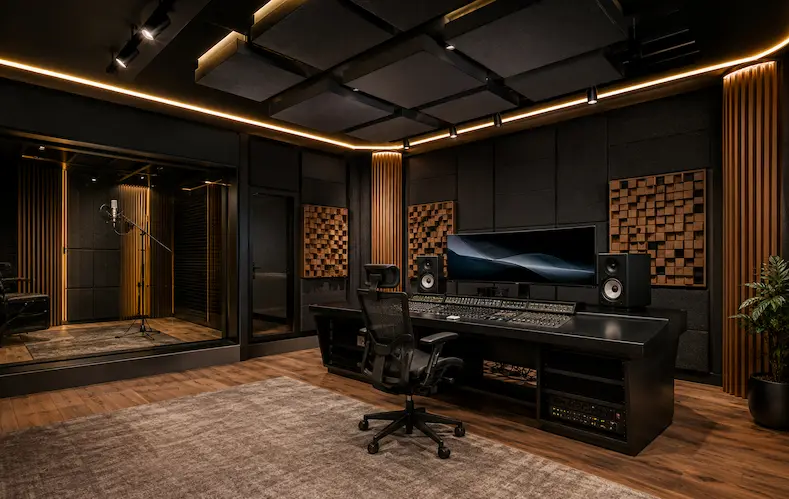
A recording studio is only as good as its acoustic environment. The most expensive microphones, preamps, and monitoring systems in the world cannot compensate for a room that colors the sound, introduces external noise into recordings, or prevents you from hearing your mix accurately. We design and install complete recording studio soundproofing and acoustic treatment systems, from ground-up studio builds to acoustic retrofits of existing rooms, engineered for the level of performance that professional recording demands.
At DM Soundproofing & Acoustics Treatment, we understand that studio acoustics is not a single product or a panel on a wall, it is a complete, layered system of sound isolation, absorption, diffusion, and low-frequency control, each element working together to create an environment where sound can be captured, monitored, and produced with accuracy and confidence.
Recording studios operate at the intersection of two distinct but equally critical acoustic requirements, sound isolation and acoustic treatment, and a failure in either one compromises the entire recording environment regardless of how well the other is addressed.
Sound isolation is concerned with what travels between the studio and the outside world. External noise from traffic, air conditioning systems, footsteps in adjacent rooms, and neighboring spaces all find their way into sensitive condenser microphones at levels that are inaudible to the human ear in normal conditions but clearly captured in a quiet recording. A vocalist performing a delicate passage, a guitarist tracking a clean acoustic part, or a podcaster recording a solo episode needs a space where the only sound being captured is the one being intentionally created. At the same time, the bass and low-mid energy generated by kick drums, bass guitars, synthesizers, and studio monitors must be contained within the room to prevent leakage into adjacent spaces, a critical consideration in residential builds, apartment studios, and shared commercial buildings.
Acoustic treatment, by contrast, is concerned with how sound behaves inside the room once it has been isolated from the outside world. An untreated room, even a well-isolated one, introduces its own set of acoustic problems: flutter echo between parallel walls, low-frequency standing waves that cause bass buildup in corners and create frequency response anomalies at the mix position, early reflections from side walls and ceilings that arrive at the listening position milliseconds after the direct sound and smear stereo imaging, and an overall reverberation character that adds coloration to recordings and prevents accurate monitoring decisions. These are not problems that better equipment solves, they are properties of the room itself, and they require acoustic treatment to address.
A properly designed recording studio soundproofing and acoustic treatment system helps you:
We design and install recording studio soundproofing and acoustic treatment systems for professional recording studios, home studios, podcast production rooms, broadcast facilities, music rehearsal rooms, voiceover booths, and film dubbing suites across Islamabad, Lahore, and Karachi, covering areas including F-7, F-8, and G-11 (Islamabad), Gulberg, DHA Phase 5, and Johar Town (Lahore), and DHA Karachi, Gulshan-e-Iqbal, and PECHS (Karachi), working with independent artists, production houses, broadcast companies, and institutional clients on projects ranging from bedroom studio conversions to purpose-built professional recording facilities.
The most effective method of achieving high levels of sound isolation in a recording studio is the room-within-a-room principle, constructing a structurally decoupled inner room that floats independently within the outer building shell, eliminating the direct structural connection through which vibration and sound energy would otherwise travel. We build floating floor systems using resilient underlayment and concrete or timber platforms, double-leaf wall assemblies with an air gap between inner and outer leaves, independent ceiling structures decoupled from the building's existing slab, and isolated mechanical connections for electrical conduit, HVAC ducts, and plumbing penetrations. This approach addresses both airborne sound transmission through the wall cavity and structure-borne vibration transmission through the building frame simultaneously, achieving the highest possible Sound Transmission Class (STC) ratings for the studio envelope.
Low-frequency energy, particularly from bass guitar, kick drums, and studio monitor bass reproduction, is transmitted through the building structure with remarkable efficiency, traveling through floors and concrete slabs to affect rooms far removed from the studio space. Floating floor systems using neoprene isolators, spring mounts, or resilient mat underlayment decouple the studio floor from the structural slab, interrupting the path through which impact and structure-borne sound would otherwise travel. We design floating floor systems to the specific mass and frequency requirements of each studio's intended use, a hip-hop production studio with heavy low-end monitoring requires a different floating floor specification than a voiceover booth or podcast room.
Standard interior doors are among the most significant weak points in any studio's sound isolation envelope, with hollow-core doors providing STC ratings as low as 20-25, barely more than an open hole in the wall. We install professional acoustic door systems with solid hardwood or steel cores, compression seals on all four edges, automatic door bottoms that deploy on closing, and in high-isolation applications, double-door airlock vestibules that create a trapped air space between two independently sealed doors, the most effective approach to door-related sound isolation, eliminating the single most common cause of isolation failure in otherwise well-built studios.
A recording studio requires adequate ventilation for comfort and air quality during long sessions, but standard HVAC ductwork is a direct acoustic pathway between the studio and the rest of the building, transmitting both the mechanical noise of the air handling unit and the sound of the studio itself through the duct system to adjacent spaces. We design dedicated studio HVAC systems using oversized low-velocity ductwork that moves air at speeds that produce minimal turbulence noise, duct silencers and acoustic baffles at supply and return points, vibration-isolated fan and air handling unit mounting, and flexible duct connections that prevent vibration transmission from mechanical equipment to the studio structure.
Low-frequency acoustic control is the most technically demanding aspect of studio acoustic treatment and the most commonly neglected in amateur studio builds. Bass frequencies, typically below 300 Hz, have wavelengths long enough that standard absorption panels have no meaningful effect on them. Dedicated bass traps, constructed from thick, high-density rockwool or glass wool and positioned in the corners and floor-ceiling junctions where low-frequency energy concentrates most intensely, are required to reduce the standing wave buildup that causes bass frequencies to be dramatically louder or quieter at specific positions in the room. Without effective bass trapping, mix decisions made at the engineer's listening position do not translate accurately to other playback systems, a bass-heavy mix in an undertreated room will sound thin on external speakers because the room was adding bass energy that wasn't present in the recording.
Fabric-wrapped broadband absorption panels constructed from high-density glass wool or polyester fiber core provide effective sound absorption across the mid and high-frequency range, controlling the early reflections, flutter echo, and excess reverberation that color recordings and degrade monitoring accuracy. We design panel placement based on acoustic measurement of the untreated room, first reflection point analysis at the mix position, and the studio's target reverberation time, ensuring that absorption is placed where it has the greatest acoustic impact rather than distributed arbitrarily around the room.
While absorption reduces reverberation by converting sound energy into heat, diffusion scatters sound energy in multiple directions without absorbing it, preserving a sense of acoustic liveliness and space in the room while eliminating the discrete reflections that cause coloration and imaging problems. Quadratic residue diffusers (QRDs) and skyline diffusers are positioned on the rear wall of control rooms and at specific points in live rooms to create a diffuse, even reverberant field that supports accurate monitoring and natural-sounding live room recordings. The combination of targeted absorption and strategic diffusion creates a balanced acoustic environment that is neither dead and lifeless nor reverberant and colored.
Vocal booths, small, highly isolated rooms within the studio used for recording vocals, voiceover, and acoustic instruments, require extremely careful acoustic design because their small dimensions make them particularly susceptible to low-frequency resonances and the claustrophobic, over-absorbed sound quality that results from treating small rooms with too much absorption and insufficient diffusion. We design vocal booths with adequate bass trapping for low-frequency control, calibrated broadband absorption for mid and high frequencies, and sufficient diffusion to preserve a natural vocal sound, combined with the door, wall, and ceiling isolation required to make the booth genuinely useful for noise-sensitive recording.
The most cost-effective point to address a recording studio's acoustic requirements is before construction begins, the right decisions during the design phase eliminate the need for expensive remediation after the room is built. We provide pre-build acoustic consultation for new studio construction projects, advising on room dimensions, surface angles, wall construction details, HVAC routing, and material specifications that produce a favorable acoustic starting point before any treatment is installed. For existing rooms, we conduct full acoustic measurement and assessment before designing a treatment program, ensuring that every element of the solution addresses a measured acoustic problem rather than a theoretical one.
Soundproofing, or sound isolation, controls what travels between the studio and the outside world, preventing external noise from entering recordings and studio sound from leaking into adjacent spaces. Acoustic treatment controls how sound behaves inside the room, addressing echo, reverberation, bass buildup, and reflection patterns that affect recording quality and monitoring accuracy. A professional studio requires both, designed together as a single integrated system, because isolation without treatment produces a room that is quiet but acoustically unusable, while treatment without isolation produces a well-balanced room that is still contaminated by external noise.
The level of isolation achievable without construction is limited by the existing room’s structure, but meaningful improvements can be made through acoustic door seals and sweeps, mass-loaded vinyl applied to walls, acoustic panels to control internal reflections, and decoupled mounting for studio monitors. For serious recording work requiring high isolation, particularly in apartments or residential areas near traffic or neighbors, some degree of construction is typically necessary to achieve the isolation levels that professional recording demands. Our site assessment determines what level of isolation is realistically achievable in your space and what construction, if any, is required to meet your goals.
The required level of isolation depends on the ambient noise level outside the studio and the sensitivity of the recording work being done inside it. As a general reference, an STC rating of 55-65 is typically sufficient for most home and semi-professional studio applications in moderate noise environments. Professional studios in urban areas near traffic, or studios used for classical or acoustic recording where noise floors must be extremely low, may require STC ratings of 70 or higher, achievable with room-within-a-room construction. We conduct ambient noise measurements at your site to determine the specific isolation target required before designing your studio.
Bass buildup in recording studios is caused by low-frequency standing waves — acoustic resonances that occur when the wavelength of a bass frequency aligns with one or more room dimensions, causing certain frequencies to be reinforced dramatically at specific positions in the room. Standard absorption panels have no effect on these resonances because their depth is insufficient to absorb long-wavelength bass energy. Dedicated bass traps constructed from thick, high-density mineral wool and positioned in room corners, where standing waves concentrate most intensely, are required to reduce these resonances to acceptable levels. Bass trapping is the single most impactful acoustic treatment in most studio spaces.
Acoustic panels alone address mid and high-frequency reflections and reverberation, which is an important part of studio acoustic treatment, but without bass trapping, diffusion, and sound isolation, panels alone are insufficient for professional recording use. A room treated only with acoustic foam or fabric panels will have controlled high-frequency response but uncontrolled bass, resulting in a mix position where low frequencies cannot be accurately evaluated. Effective studio acoustics requires bass traps, broadband panels, and diffusers working together within an adequately isolated room.
An acoustic measurement session in your existing room will reveal the reverberation time, frequency response anomalies, standing wave patterns, and ambient noise level, providing objective data on what the room needs. Rooms with significant bass buildup, strong flutter echo, and poor monitoring translation typically need acoustic treatment. Rooms where external noise appears in recordings, or where studio sound disturbs adjacent spaces, need soundproofing intervention. Many existing studio spaces need both, and our measurement-based approach ensures that the treatment program we design addresses the actual acoustic problems in your specific room rather than a generic assumption about what studio treatment should look like.
Yes, though the level of isolation achievable in a residential building depends on the building’s existing construction, the proximity of neighbors, and the ambient noise environment. We have completed apartment studio projects using floating floor systems, decoupled wall and ceiling constructions, and acoustic door vestibules that achieve sufficient isolation for most recording applications. We conduct a thorough site assessment of every residential studio project before design begins, to establish what is structurally possible and what isolation levels can realistically be achieved within the building’s constraints.
A home studio acoustic treatment, bass traps, broadband panels, and diffusers in an existing room, is typically completed within one to two weeks. A more involved project including floating floor, decoupled walls, acoustic doors, and HVAC treatment may take three to six weeks depending on the scope of construction. Full room-within-a-room builds for professional facilities are project-specific and typically require a detailed construction schedule agreed before work begins.
Yes. Podcast rooms and voiceover booths have specific acoustic requirements — extremely low reverberation for clean, broadcast-quality speech recording, combined with sufficient isolation to prevent external noise from appearing in recordings. We design dedicated voiceover and podcast room systems with calibrated absorption, adequate bass control, acoustic door seals, and where needed, full isolation construction, ensuring the room delivers the quiet, controlled acoustic environment that broadcast-quality speech recording requires.
Get a free on-site acoustic assessment and a custom studio soundproofing plan, no obligation, no hidden costs.