

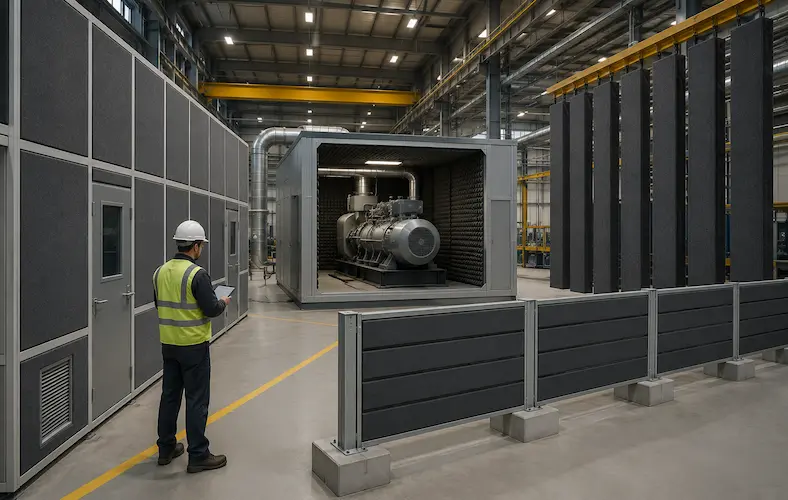
Industrial environments generate noise levels that standard construction was never built to handle, from compressors and generators to CNC machines, HVAC systems, and production lines running around the clock. We design and install industrial-grade soundproofing and noise control systems that protect your workforce, meet occupational safety standards, and reduce noise impact on surrounding communities.
At DM Soundproofing & Acoustics Treatment, we combine acoustic engineering with heavy-duty, imported sound-dampening materials built to withstand industrial conditions, vibration, heat, humidity, and continuous operation.
Industrial noise isn’t just an inconvenience, it’s a measurable occupational hazard. Continuous exposure to machinery noise above 85 decibels (dB), the threshold recognized by occupational safety standards, contributes to noise-induced hearing loss (NIHL), reduced worker concentration, increased error rates, and long-term liability exposure for facility owners. Beyond the factory floor, unchecked industrial noise can also lead to community noise complaints, regulatory penalties, and strained relationships with neighboring residential or commercial zones.
A properly engineered industrial soundproofing system helps you:
Industrial acoustics isn’t a single fix, it requires a layered approach addressing airborne noise, structure-borne vibration, and impact noise simultaneously.
We design and install industrial noise control systems for factories, manufacturing plants, warehouses, power generation facilities, packaging units, textile mills, and processing plants across Islamabad, Lahore, and Karachi, including major industrial zones such as I-9 and I-10 Industrial Area (Islamabad), Sundar Industrial Estate and Quaid-e-Azam Industrial Estate (Lahore), and SITE Industrial Area and Korangi Industrial Area (Karachi).
Custom-built acoustic enclosures constructed from layered steel, mineral wool, and mass-loaded vinyl (MLV) contain noise directly at the source, compressors, generators, pumps, chillers, and CNC machines. These enclosures are engineered with ventilation systems to prevent overheating while maintaining maximum sound attenuation, often achieving noise reduction of 20-35 dB depending on equipment type and enclosure design.
Heavy machinery transmits vibration through floors and structural elements, often causing noise to travel far beyond the equipment's immediate location. We install vibration isolation mounts, spring isolators, and neoprene pads beneath equipment to decouple machinery from the building structure, preventing structure-borne noise transmission to offices, control rooms, and adjacent facilities.
High-density acoustic barriers combining sound-absorbing foam, rockwool insulation, and mass-loaded vinyl layers are installed on factory walls and ceilings to reduce reverberation and contain airborne noise within designated zones, protecting workers in less noisy sections of the facility.
For ventilation openings, exhaust systems, and intake vents where solid barriers aren't practical, we install acoustic louvers and duct silencers that allow airflow while significantly reducing noise transmission through openings, critical for HVAC systems, generator exhausts, and compressor intakes.
Supervisors and administrative staff working near production floors need acoustically isolated control rooms and offices. We construct soundproof partition walls, acoustic doors, and laminated glass observation windows that maintain visual oversight of operations while blocking machinery noise.
Every facility has a unique noise profile shaped by equipment type, layout, building materials, and operational hours. Our team conducts on-site noise level measurements and mapping to identify primary noise sources, then engineers a layered solution combining the appropriate mix of enclosures, barriers, isolation, and absorption, rather than applying generic materials that don't address the actual problem.
Occupational safety guidelines generally flag continuous exposure above 85 decibels (dB) as requiring mitigation, whether through engineering controls like soundproofing or administrative measures like exposure time limits. We conduct on-site noise measurements to determine actual decibel levels and recommend the appropriate level of intervention.
In most cases, yes. We schedule installation work in phases around your production timeline, and many solutions like acoustic enclosures and vibration isolation mounts can be installed with minimal downtime.
No. Our acoustic enclosures are engineered with proper ventilation systems, including baffled vents and, where needed, forced-air cooling, to maintain safe operating temperatures while still achieving significant noise attenuation.
Yes. Industrial noise control requires treating both, airborne noise through barriers and enclosures, and structure-borne vibration through isolation mounts and decoupling systems. Treating only one typically leaves the underlying noise problem unresolved.
Reduction levels vary based on equipment type, enclosure design, and existing building construction, but well-engineered industrial soundproofing systems typically achieve 20-35 dB of noise reduction at the source, with additional reduction from barriers and isolation in surrounding areas.
Both. We’ve completed projects ranging from single-machine enclosures in small workshops to facility-wide noise control programs across multi-unit industrial plants.
Most systems require minimal maintenance, though periodic inspection of vibration isolators, enclosure seals, and acoustic barriers is recommended to ensure continued performance, especially in high-heat or high-vibration environments.
Yes. Acoustic barriers, enclosures, and exhaust silencers significantly reduce noise transmission beyond facility boundaries, which is often the primary driver of noise complaints from neighboring residential or commercial areas.
Get a free on-site noise assessment and a custom industrial soundproofing plan, no obligation, no hidden costs.